
STAR Method Interview Examples: How to Structure Answers That Get You Hired
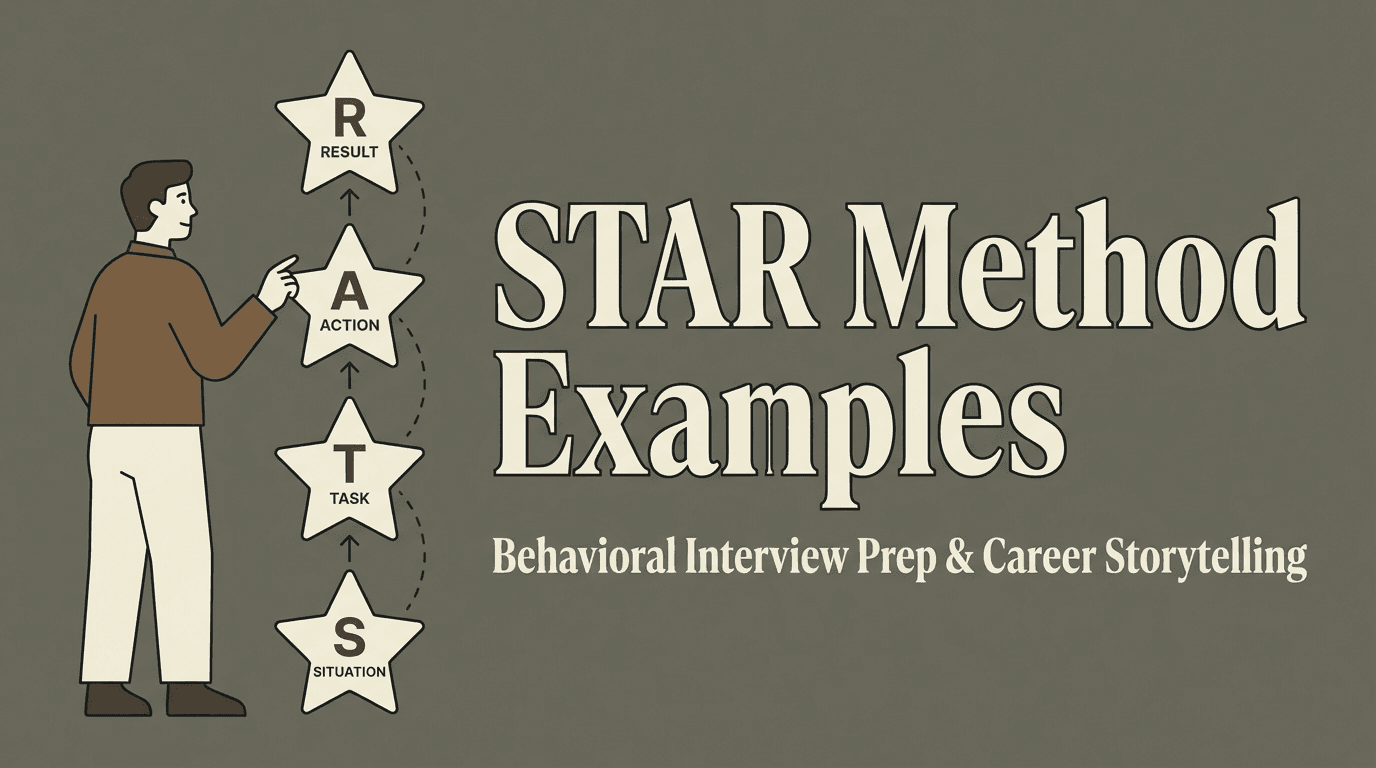
You know the STAR method exists. Situation, Task, Action, Result. Simple enough in theory. But when an interviewer asks "Tell me about a time you dealt with a difficult coworker," most people still ramble for four minutes without landing anywhere useful.
The gap isn't knowledge — it's execution. This guide breaks down the STAR method with concrete examples so you can see exactly what good looks like and build your own answers that actually land.
The STAR Method, Briefly
STAR stands for:
- Situation — Set the scene. Where were you? What was happening?
- Task — What was your specific responsibility or challenge?
- Action — What did you actually do? (This is the meat.)
- Result — What happened? Quantify it if you can.
That's the framework. Now let's see it in practice.
Example 1: "Tell Me About a Time You Led a Project"
Weak Answer
"I led a migration to a new database last year. It went well. We planned everything out and the team executed on time. Everyone was happy with the result."
This answer checks no boxes. There's no context, no detail about what you did, and "everyone was happy" isn't a result.
STAR Answer
Situation: "Last year, our team's primary database was hitting performance limits. Page load times had increased by 40% over six months, and we were starting to lose users during peak hours."
Task: "I was asked to lead the migration to a new database system. I was responsible for choosing the technology, planning the migration timeline, and coordinating across three engineering teams."
Action: "I started by benchmarking three database options against our specific query patterns — not just general performance specs. I built a proof of concept with the top candidate, then created a phased migration plan that let us move tables incrementally without downtime. I held weekly syncs with the other teams to coordinate schema changes and ran two rehearsal migrations in staging before touching production."
Result: "We completed the migration in six weeks with zero downtime. Page load times dropped by 60%, and our infrastructure costs decreased by about $2,000 per month because the new system was more efficient with our workload."
Why this works: The answer is specific, shows leadership and technical decision-making, and ends with measurable results. The interviewer can clearly see what you did versus what the team did.
Example 2: "Describe a Time You Disagreed with a Teammate"
Weak Answer
"I disagreed with a coworker about how to build a feature. We talked about it and eventually agreed on a solution."
This tells the interviewer nothing about how you handle conflict.
STAR Answer
Situation: "During a sprint planning session, a senior engineer proposed building our new notification system as a monolithic service. I believed a microservice approach would be more maintainable and scalable given our growth trajectory."
Task: "I needed to advocate for what I thought was the better technical approach without undermining a respected colleague or derailing the sprint."
Action: "Instead of debating in the meeting, I asked if we could timebox the decision for two days. I put together a short document comparing both approaches across five criteria: development speed, scalability, operational complexity, team familiarity, and migration risk. I shared it with the team and invited the other engineer to add his perspective to the same doc. We scheduled a 30-minute review where everyone could weigh in with the tradeoffs clearly laid out."
Result: "The team decided on a hybrid approach — starting with a simpler monolithic design but structuring the code so we could extract services later. Both of us felt heard, and the decision was better than either original proposal. The system has been running for eight months without any major refactoring needs."
Why this works: It shows emotional intelligence, structured thinking, and collaboration. The result demonstrates that the candidate was more interested in the right outcome than in winning the argument.
Example 3: "Tell Me About a Time You Failed"
This question trips people up because they either pick something trivial ("I'm a perfectionist") or share something genuinely damaging without framing the learning.
STAR Answer
Situation: "Six months into my role, I was responsible for launching a new onboarding flow for our mobile app. We had user research suggesting the existing flow was causing a 35% drop-off rate."
Task: "I owned the redesign from research through launch, including coordinating with design, engineering, and marketing."
Action: "I was so focused on hitting our launch deadline that I shortened our testing phase from two weeks to three days. I pushed to ship based on a small internal beta rather than a broader A/B test. I also didn't loop in the support team, so they weren't prepared for the new flow."
Result: "The new onboarding flow actually increased drop-off by 8% in the first week. We also saw a spike in support tickets because the team wasn't briefed. I immediately set up an A/B test reverting 50% of users to the old flow, which confirmed the problem. Within two weeks, we identified the specific screen causing confusion — a step that made sense to us internally but was unclear to new users. After fixing it, drop-off decreased by 28% compared to the original. The experience taught me that speed without validation is just moving fast in the wrong direction. I now build testing checkpoints into every project timeline, and I created a launch checklist that includes cross-team communication."
Why this works: It's an honest failure with real consequences, but the focus is on the learning and the systemic changes made afterward. Interviewers aren't looking for perfection — they're looking for self-awareness and growth.
How to Build Your Own STAR Stories
You need 5-7 polished stories that can flex across multiple questions. Here's how to build them:
Step 1: Identify Your Best Material
Look through the last 2-3 years of your career for moments that involved:
- Leading a project or initiative
- Solving a hard technical problem
- Navigating conflict or disagreement
- Failing and recovering
- Mentoring or helping someone grow
- Making a decision under uncertainty
- Delivering results under pressure
Step 2: Write Them Out
For each story, write the full STAR structure. Don't skip this step — writing forces clarity that mental rehearsal doesn't.
Keep each component focused:
- Situation: 2-3 sentences max. Just enough context.
- Task: 1-2 sentences. What was specifically on you?
- Action: This should be the longest section. Be specific about your actions, not the team's.
- Result: Quantify when possible. Even rough numbers ("reduced by about 30%") are better than vague outcomes ("it went well").
Step 3: Practice Out Loud
Reading your stories silently is not preparation. Speaking them out loud is. You'll immediately notice when a story is too long, when transitions feel awkward, or when you're missing important details.
This is where practice tools become essential. Running through your STAR stories with Mocker lets you practice delivering them in a realistic interview setting — complete with follow-up questions that test whether you can go deeper on the details.
Step 4: Map Stories to Common Questions
Most behavioral questions cluster around a few themes. Map your stories so you know which one to reach for:
| Theme | Story to Use |
|---|---|
| Leadership | Project migration story |
| Conflict | Notification system disagreement |
| Failure | Onboarding flow launch |
| Technical challenge | Performance optimization story |
| Mentoring | Junior engineer coaching story |
Having this mental map means you're never caught off guard. When a question comes up, you already know which story fits.
Common STAR Mistakes
Too much Situation, not enough Action. Spending two minutes on context and 30 seconds on what you did is backwards. Keep the setup tight.
Using "we" instead of "I." Interviewers want to know what you did. It's fine to acknowledge teamwork, but be clear about your specific contributions.
No measurable Result. "It went well" or "the client was happy" are weak endings. Push yourself to include numbers, percentages, timelines, or other concrete outcomes.
Only one story for everything. If you're using the same story for every question, it signals limited experience. Prepare enough variety to demonstrate range.
Start Practicing Today
The STAR method is simple, but simple doesn't mean easy. The difference between a candidate who knows the framework and one who's actually practiced using it is immediately obvious to any interviewer.
Write your stories out. Say them out loud. Get feedback. Refine. Repeat.
If you want to practice delivering STAR answers in a realistic setting, Mocker runs AI-powered voice mock interviews that adapt to your responses and give you specific feedback on structure, clarity, and depth. It's the fastest way to go from knowing the STAR method to actually nailing it in an interview.
Your stories are already there — you just need to learn how to tell them.