
How to Prepare for Technical Interviews: A Practical Guide for Software Engineers
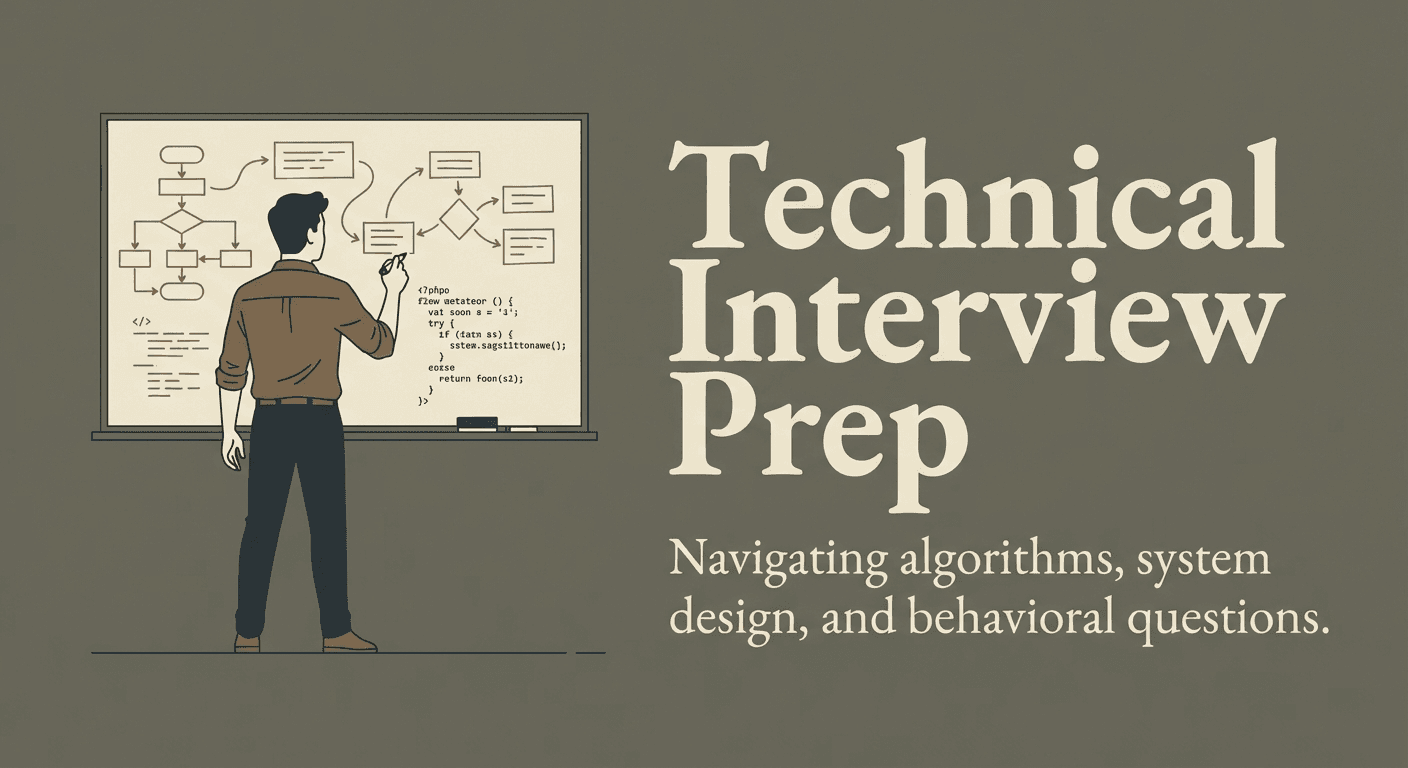
Technical interviews are their own skill set. You can be a strong engineer and still struggle with them — the format, the time pressure, and the specific types of problems asked don't always reflect day-to-day work. That's frustrating, but it's also fixable.
Preparation is what closes the gap between your actual abilities and your interview performance. This guide covers how to prepare effectively across every stage of the technical interview process.
Understand What You're Preparing For
Technical interviews aren't monolithic. Depending on the company and level, you might face some or all of these:
- Coding rounds — solving algorithmic problems in real time, usually on a whiteboard or shared editor.
- System design — architecting a large-scale system (more common for mid-level and senior roles).
- Behavioral questions — explaining past experiences, leadership, conflict resolution.
- Take-home projects — building something on your own time (less common but still around).
- Live debugging or code review — reading and improving existing code.
Before you start studying, find out what format your target companies use. Check Glassdoor, Blind, or Levels.fyi for interview breakdowns. Preparing for system design when the company only does pair programming wastes valuable time.
Build a Coding Practice Plan
Coding rounds are the most common component, so they deserve the most structured preparation.
Start with Fundamentals
If it's been a while since you've worked with data structures and algorithms outside of your daily codebase, start with a review:
- Arrays and strings — two-pointer techniques, sliding windows, prefix sums
- Hash maps — frequency counting, grouping, lookups
- Trees and graphs — BFS, DFS, traversals
- Dynamic programming — start with simple 1D problems before jumping to 2D
- Sorting and searching — binary search variations come up constantly
You don't need to memorize algorithms. You need to recognize patterns and understand when to apply which approach.
Practice Deliberately
Grinding 300 LeetCode problems without reflection teaches you very little. Instead:
- Time yourself. Give yourself 25-30 minutes per medium problem. This builds the time pressure tolerance you'll need.
- Talk out loud. Explain your thought process as you work. In real interviews, communication matters as much as the solution.
- Review solutions you didn't get. Don't just read the answer — understand why that approach works and what pattern it uses.
- Revisit problems after a few days. If you can't re-solve a problem you previously looked up the answer for, you didn't actually learn it.
Aim for 3-5 problems per day over weeks, not 20 problems in a weekend. Spaced repetition beats cramming every time.
Focus on Patterns, Not Problems
There are roughly 15-20 core patterns that cover the vast majority of coding interview questions. Learn to identify them:
- Sliding window
- Two pointers
- Fast and slow pointers
- Merge intervals
- Cyclic sort
- BFS/DFS
- Top K elements
- Binary search variations
- Backtracking
Once you can identify which pattern a problem uses, you're halfway to the solution.
Prepare for System Design
If you're interviewing for mid-level or senior roles, system design rounds are where you can really stand out — or fall flat.
Learn the Building Blocks
You don't need to be an infrastructure expert, but you should understand:
- Load balancers — how traffic gets distributed
- Caching layers — Redis, CDNs, and cache invalidation strategies
- Databases — SQL vs. NoSQL, sharding, replication, indexing
- Message queues — Kafka, RabbitMQ, async processing
- API design — REST, GraphQL, rate limiting
Practice a Structured Approach
System design interviews are open-ended by nature. Having a framework keeps you organized:
- Clarify requirements. Ask about scale, users, core features, and constraints. Don't assume.
- Outline the high-level design. Draw the major components and how they connect.
- Dive into key components. Pick the most critical or complex parts and design them in detail.
- Address trade-offs. Every design decision has trade-offs. Discussing them shows maturity.
- Consider scaling and failure modes. What happens when traffic spikes? When a service goes down?
Practice by designing real systems: URL shortener, Twitter feed, chat application, notification system. Talk through your design out loud — this is a communication exercise as much as a technical one.
Don't Neglect Behavioral Questions
Many engineers under-prepare for behavioral rounds because they feel less "technical." This is a mistake, especially at senior levels where behavioral performance can outweigh coding.
Prepare 5-7 stories from your experience that cover common themes:
- A technically challenging project you led
- A time you disagreed with a teammate or manager
- A failure and what you learned from it
- A situation where you had to make a decision with incomplete information
- A time you mentored someone or helped a team improve
Structure each story using the STAR method (Situation, Task, Action, Result) to keep your answers focused and concise. Practice telling them out loud — the difference between a written story and a spoken one is significant.
Tools like Mocker are especially useful here. Practicing behavioral answers with an AI interviewer that asks follow-up questions helps you refine your stories in a way that reading them off a document never will.
Create a Study Schedule
A realistic study plan matters more than the perfect study plan. Here's a framework that works for most people:
4-6 Weeks Out
- Review data structures and algorithm fundamentals
- Start solving easy/medium coding problems (2-3 per day)
- Read one system design case study per week
- Draft your behavioral stories
2-3 Weeks Out
- Shift to medium/hard coding problems
- Practice system design out loud (use a whiteboard or draw.io)
- Run mock interviews — either with a friend or an AI tool
- Refine behavioral stories based on practice feedback
Final Week
- Focus on company-specific patterns (check what they tend to ask)
- Do 2-3 full mock interviews under realistic conditions
- Review your weakest areas one more time
- Rest the day before — showing up exhausted helps no one
Consistency beats intensity. An hour a day for four weeks will prepare you better than a frantic weekend of 12-hour study sessions.
Common Mistakes to Avoid
Jumping straight to code. In coding rounds, always talk through your approach first. Interviewers want to see your thinking, not just a working solution.
Memorizing solutions. If you've memorized the answer to a specific problem but can't adapt when the interviewer changes a constraint, it's obvious — and it looks bad.
Ignoring communication. Technical interviews assess whether you can explain your thinking to other engineers. Practice narrating your thought process, asking clarifying questions, and discussing trade-offs.
Only practicing in your head. Reading a question, thinking "I'd use a hash map," and moving on is not practice. Write the code. Say the words out loud. The gap between knowing and doing is exactly what interviews test.
Skipping mock interviews. Solving problems alone and performing in a live interview are different skills. Mock interviews — whether with peers or AI tools like Mocker — bridge that gap by adding the pressure of real-time conversation and follow-up questions.
Final Thoughts
Technical interview prep is a grind, but it's a structured, learnable grind. The engineers who land offers at top companies aren't necessarily smarter — they're more prepared.
Build a plan, practice consistently, and don't skip the parts that feel uncomfortable (especially behavioral questions and speaking out loud). Every hour you invest in deliberate practice directly improves your odds.
Start today. Your future self will thank you.